 By carl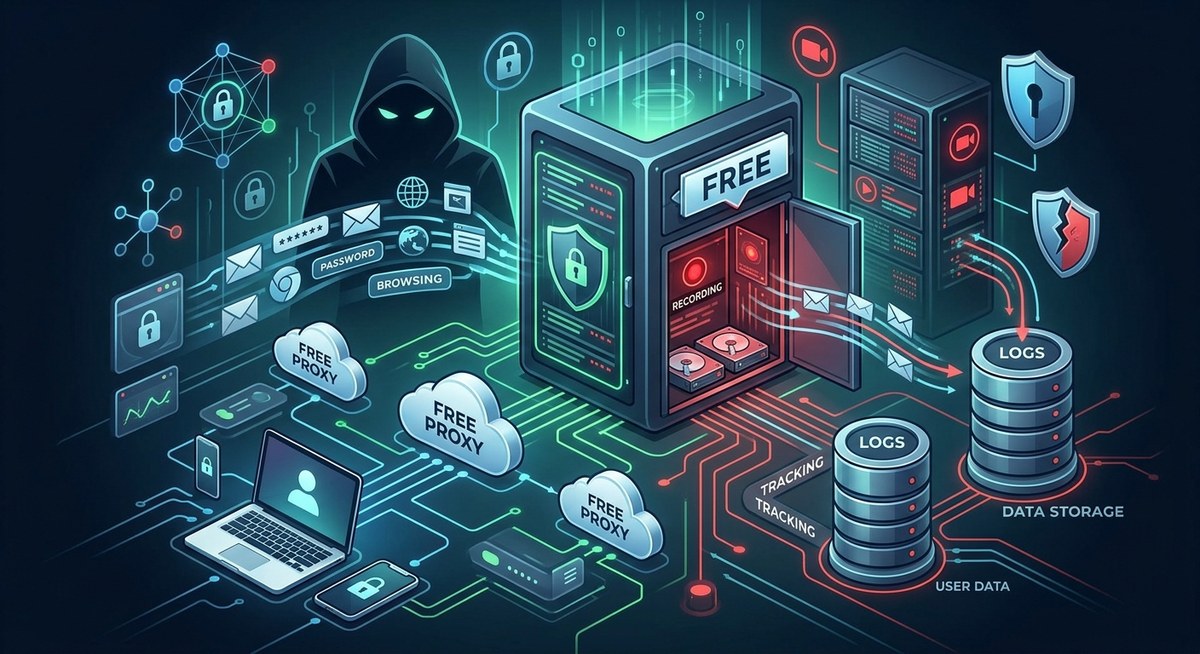
You type a URL into your browser, hit enter, and hope the free proxy server you grabbed from a list is doing its job. Maybe you are trying to bypass a geo-restriction for a news article or just want a little extra privacy at a coffee shop. The IP address changes. The site loads. It feels like a win. But what you do not see is the transaction happening behind the screen. That free proxy server is recording every site you visit, every form you fill out, and every login you type. And nobody running that server has any legal obligation to keep it secret.
Free proxy lists are not curated for your safety. Most are scraped from public sources, and many servers are operated by unknown parties who log everything. You trade your browsing history, credentials, and personal data for a few minutes of anonymous browsing. The real cost is your privacy, and it is almost never worth the risk.
The Hidden Business Model Behind Free Proxy Lists
Running a proxy server costs money. Bandwidth, electricity, server maintenance. None of that is free. So when you find a list offering hundreds of free proxies, someone is paying the bill. And that someone expects a return.
The most common model is data logging. The operator captures your HTTP requests, your DNS queries, and sometimes even your HTTPS headers. They sell that data to advertisers, marketing firms, or worse. Some operators inject JavaScript into pages you visit, hijacking your session to display ads or redirect you to affiliate links. A few even run credential harvesting operations, where they look for login forms and capture usernames and passwords in plain sight.
Think about that for a second. If you logged into your bank, your email, or your social media account through a free proxy, the person running that server could have seen it all.
What Free Proxy Lists Actually Log
Most people assume a proxy only sees the destination IP and a few metadata headers. That is incorrect. Depending on the protocol and your browser behavior, a proxy can capture a shocking amount of information.
| Data Type | HTTP Proxy | HTTPS Proxy (MITM) | SOCKS5 Proxy |
|---|---|---|---|
| Destination URL | Full URL visible | Only hostname (if no MITM) | IP address only |
| Request headers | Fully visible | Partially visible | Not visible |
| POST data (form fields) | Visible | Visible if decrypted | Not visible |
| DNS queries | Visible to proxy | Visible to proxy | Visible to proxy |
| Cookies | Visible | Visible if decrypted | Not visible |
| Content body | Visible | Visible if decrypted | Not visible |
A standard HTTP proxy sees everything. An HTTPS proxy that does not perform a man-in-the-middle attack will only see the hostname, but your DNS requests still leak through. And DNS queries reveal exactly which sites you visit, even if the content is encrypted.
SOCKS5 is better because it operates at a lower level. It does not parse your traffic. But the DNS lookup still happens through the proxy unless you configure DNS-over-HTTPS separately. So even with SOCKS5, the operator knows which domains you are visiting.
The Three Biggest Risks You Cannot Ignore
1. Credential Theft Through Form Injection
This is the nightmare scenario. A malicious proxy operator watches for traffic to login pages. When your browser sends a POST request with your email and password, the server captures it before forwarding it to the real site. You log in successfully, never knowing the proxy just made a copy of your credentials.
This attack is especially dangerous on HTTP sites, but even HTTPS is not safe if the proxy uses a self-signed certificate that your browser accepts. Some free proxy lists intentionally provide servers that have been compromised or set up specifically for this purpose.
2. Session Hijacking and Cookie Theft
Cookies are the keys to your online accounts. If a proxy captures your session cookie, the operator can impersonate you on that site without needing your password. They can read your emails, post on your social media, or initiate transactions on shopping sites.
Session hijacking is harder with HTTPS, but many free proxies are HTTP-only. If you accidentally send a cookie over an HTTP connection, the proxy sees it immediately.
3. Malware and Botnet Recruitment
Some free proxy servers do not just log data. They infect your device. The proxy might inject a script into a webpage that tries to download malware onto your machine. Or the server itself might be part of a botnet, using your connection as a relay for attacks on other systems.
If you connect to a proxy that is part of a botnet, your IP address gets associated with malicious activity. You could end up on blocklists, lose access to certain services, or even get investigated by your ISP.
How to Spot a Dangerous Free Proxy List
Not every free proxy list is malicious, but most are risky. Here are the red flags to watch for:
- The list contains hundreds of IPs with no uptime or latency data
- The proxies are all on port 80 (HTTP) with no HTTPS support
- The website hosting the list is filled with pop-up ads and suspicious redirects
- The list is scraped from public sources and not tested for safety
- The proxies are located in countries with weak privacy laws
- The list has not been updated in weeks or months (stale proxies are often hijacked)
If you see any of these signs, do not use that list. The risk is simply too high.
A Safer Approach: How to Test a Free Proxy Before Trusting It
If you absolutely must use a free proxy, you need to verify it first. Here is a step-by-step process that will catch most malicious servers.
-
Set up a virtual machine or a sandboxed environment. Never test a suspicious proxy on your main computer. Use a disposable VM or a live boot USB.
-
Check for DNS leaks. Visit a site like whatismyipaddress.com and confirm the IP matches the proxy. Then check if your real ISP’s DNS servers are visible. If they are, the proxy is leaking.
-
Send a test credential through an HTTP site. Create a dummy account on a random forum. Log in through the proxy. Then check if that account gets compromised within 24 hours.
-
Monitor network traffic with Wireshark. Filter for HTTP POST requests. If you see any requests going to unknown IPs after you log in, the proxy is likely exfiltrating data.
-
Use a tool like curl to send a request and inspect headers. Look for extra headers added by the proxy, like X-Forwarded-For or Via. Unexpected headers can indicate tampering.
-
Check the proxy’s certificate for HTTPS sites. If the certificate is self-signed or does not match the site you are visiting, the proxy is performing a MITM attack.
-
Run a traceroute. If the proxy routes your traffic through multiple unknown hops, it is likely logging or modifying your data.
This process takes about 15 minutes. It is tedious, but it can save you from a serious privacy breach. For a more thorough walkthrough, read our guide on how to test if your free proxy is actually safe.
Why Most Free Proxies Fail at Privacy
There is a fundamental misunderstanding about what a proxy does. A proxy changes your IP address. That is it. It does not encrypt your traffic. It does not protect your DNS queries. It does not prevent WebRTC leaks. And it certainly does not stop the proxy operator from watching everything you do.
Many people assume a proxy is like a VPN. It is not. A VPN encrypts the entire tunnel between your device and the server. A proxy only routes specific traffic, and often without encryption. The difference is enormous.
If you are serious about privacy, you need encryption at every layer. That means using a VPN, or at minimum, an HTTPS proxy combined with DNS-over-HTTPS. Even then, the proxy operator can still see your destination hostnames. The only way to hide that is with a VPN or Tor.
What the Experts Recommend
“If you are not paying for the product, you are the product. Free proxy lists are the digital equivalent of letting a stranger read your mail before you send it. They see everything, and they owe you nothing. Use a reputable VPN or a paid proxy service if you value your privacy.” — Security researcher and privacy advocate
That quote sums it up. Free proxy lists are not a privacy tool. They are a privacy risk dressed up as a convenience.
Better Alternatives to Free Proxy Lists
You have options that do not involve handing your data to strangers.
-
Use a paid VPN service. A good VPN encrypts your traffic, hides your DNS queries, and does not log your activity. The cost is a few dollars a month. Compare that to the cost of a stolen identity.
-
Use a reputable paid proxy provider. Companies like Bright Data, Oxylabs, and Smartproxy offer residential and datacenter proxies that are tested and maintained. They have clear logging policies and customer support.
-
Use Tor Browser. Tor routes your traffic through three random nodes and encrypts it at each hop. It is slower than a proxy, but it is designed for anonymity.
-
Use a SOCKS5 proxy with a VPN. This combination gives you the routing control of a proxy with the encryption of a VPN. It is more complex to set up, but it is one of the most secure configurations available.
-
Set up your own proxy server on a cheap VPS. You control the hardware, the software, and the logs. It takes an hour to configure, and you pay only for the server rental.
For a deeper comparison, check out our article on free proxy vs paid proxy: which one actually protects you.
What to Do If You Already Used a Free Proxy List
If you have already used a free proxy from a list, do not panic. But do take action.
- Change your passwords for every account you accessed through that proxy.
- Enable two-factor authentication on all important accounts.
- Check your browser for suspicious extensions or changed settings.
- Run a malware scan on your device.
- Monitor your financial accounts for unauthorized transactions.
- Consider freezing your credit if you entered sensitive financial information.
The damage may already be done, but these steps can limit it.
Your Privacy Is Worth More Than Free
Free proxy lists promise anonymity but deliver surveillance. They are a gamble where the house always wins. The operator logs your data, sells it, or uses it against you. You walk away thinking you are hidden, but your digital footprint is wider than ever.
The internet in 2026 is not friendly to the unprepared. Data brokers, advertisers, and malicious actors are all looking for easy targets. Do not make yourself one by trusting a free proxy list.
Take the time to set up a proper privacy solution. Your future self will thank you.
If you want to learn more about the specific dangers, read our guide on 7 red flags that your free proxy list is stealing your data. And if you are ready to move to a safer option, our article on how to find safe free proxy servers that protect your privacy will point you in the right direction.