 By carl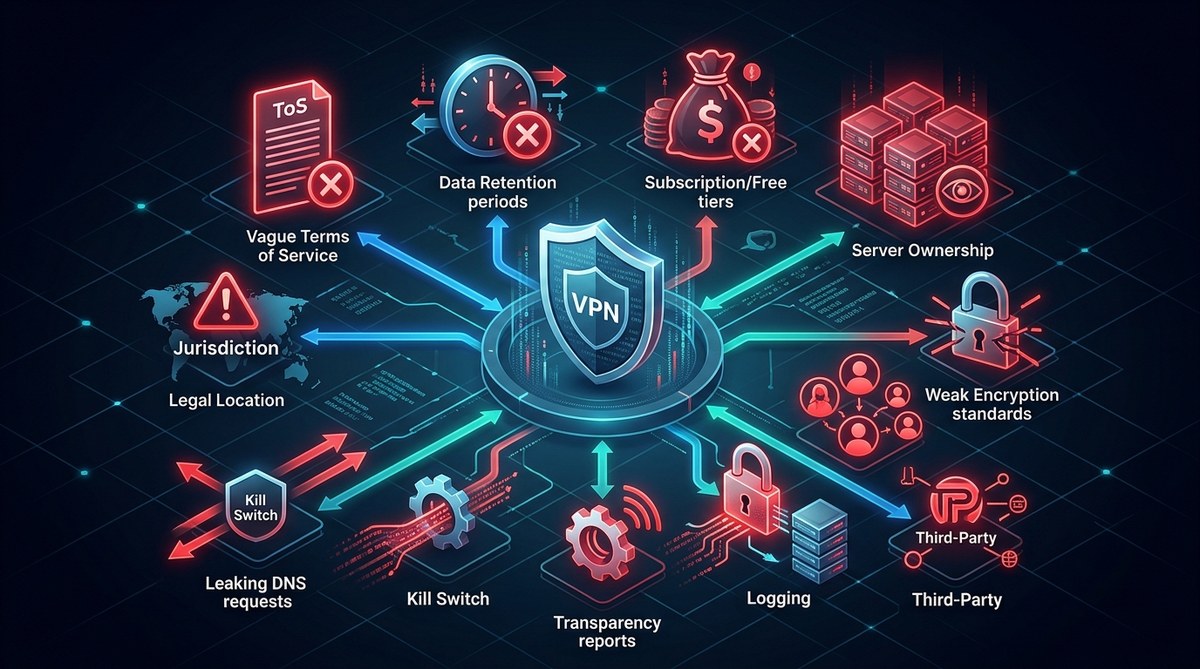
Your VPN provider promises complete privacy. But behind that sleek marketing page, they might be recording every website you visit, every file you download, and every connection you make. The truth is that many VPN services claim to protect your data while quietly maintaining detailed logs of your online activity. Some providers even sell this information to third parties or hand it over to authorities without hesitation.
Not all VPN providers honor their privacy promises. Warning signs include vague logging policies, suspicious ownership structures, free service models, jurisdiction in surveillance-friendly countries, lack of independent audits, and previous data breaches. Understanding these red flags helps you choose a VPN that actually protects your browsing activity instead of monetizing it.
Vague or Missing Privacy Policies
A legitimate VPN provider publishes a clear, detailed privacy policy that explains exactly what data they collect and what they do with it.
When you see phrases like “minimal logging” or “limited data collection” without specific details, that’s your first warning. These terms mean nothing without context.
A trustworthy policy breaks down every data point:
- Connection timestamps
- Bandwidth usage
- Server selections
- IP addresses
- DNS queries
- Payment information
The best providers state explicitly that they collect zero logs of your browsing activity. They explain what technical data they need to run the service and nothing more.
If the privacy policy uses confusing legal language or contradicts itself, assume the worst. Companies that respect your privacy make their policies readable by normal humans, not just lawyers.
Ownership Hidden Behind Shell Companies
Many VPN services hide their true ownership structure behind layers of parent companies, subsidiaries, and offshore registrations.
This secrecy serves a purpose. It makes accountability nearly impossible.
When a data breach happens or authorities request user logs, these complicated ownership chains let everyone point fingers at someone else. Nobody takes responsibility.
Research who actually owns your VPN. If you find a maze of holding companies registered in privacy havens with no real people attached, that’s a red flag.
Transparent providers list their leadership team, physical office locations, and corporate registration details publicly. They want you to know who runs the company and where to find them if something goes wrong.
| Red Flag | What to Look For | Why It Matters |
|---|---|---|
| Shell company ownership | Multiple layers of parent companies | Makes legal accountability impossible |
| No leadership information | Missing founder or executive details | No one to hold responsible for breaches |
| Offshore registration only | Companies registered in tax havens | Designed to avoid transparency laws |
| Frequent ownership changes | Company sold multiple times | Suggests profit motive over privacy mission |
Free VPN Services That Need Revenue Somehow
Running a VPN network costs serious money. Servers, bandwidth, maintenance, support staff, and security infrastructure all require ongoing investment.
Free VPN providers need to make money somehow.
The business model usually involves selling your data to advertisers, injecting tracking cookies into your browser, or redirecting your traffic through affiliate links. Some free services even sell bandwidth to other users, turning your device into an exit node without your knowledge.
Are free VPNs selling your data? The truth about zero-cost privacy tools explains exactly how these services monetize their users.
A few free VPNs operate as loss leaders for premium services, offering limited data or slower speeds to encourage upgrades. These models can work if the company clearly states their business strategy.
But if you cannot figure out how a free VPN makes money, you are the product.
Jurisdiction in Surveillance-Friendly Countries
Where your VPN provider operates determines which laws they must follow and which government agencies can demand user data.
Countries in the Five Eyes, Nine Eyes, and Fourteen Eyes intelligence alliances share surveillance data with each other. A VPN based in any of these jurisdictions can be compelled to log user activity and hand it over.
These alliances include:
- United States
- United Kingdom
- Canada
- Australia
- New Zealand
- Denmark
- France
- Netherlands
- Norway
- Germany
- Belgium
- Italy
- Spain
- Sweden
Some providers claim that strong local privacy laws protect them even in these countries. That argument falls apart when national security letters or gag orders arrive. These legal tools force companies to cooperate with surveillance while prohibiting them from telling users.
The safest VPN providers operate in countries with strong privacy protections and no mandatory data retention laws. Switzerland, Iceland, and the British Virgin Islands offer better legal frameworks for privacy services.
No Independent Security Audits
A VPN provider can claim anything in their marketing materials. Independent audits verify those claims.
Third-party security firms examine the VPN’s code, infrastructure, and logging practices. They test whether the service actually does what it promises.
Look for recent audits from reputable firms like Cure53, NCC Group, or Deloitte. The audit reports should be publicly available, not just mentioned in a blog post.
Some providers publish audit results but hide the methodology. Full transparency means sharing the complete report, including any vulnerabilities found and how they were fixed.
Regular independent audits demonstrate that a VPN provider has nothing to hide. Companies that refuse auditing or keep results private should raise immediate suspicion about their actual logging practices.
Annual audits matter more than one-time reviews. Privacy practices can change after an acquisition, software update, or policy revision. Ongoing verification proves continued commitment to privacy.
Logging Policies That Changed After Launch
Many VPN services start with strong privacy promises, then quietly update their terms of service to allow more data collection.
These changes rarely come with big announcements. Instead, providers update their privacy policy and send a generic email that most users ignore.
Track down old versions of the privacy policy using the Wayback Machine. Compare them to current terms. Look for new categories of collected data or expanded sharing permissions.
Common policy changes that signal trouble:
- Adding connection timestamps when they previously logged nothing
- Expanding data sharing with “trusted partners”
- Removing specific promises about log deletion
- Adding vague language about “improving services”
- Introducing analytics or tracking tools
- Changing data retention periods from days to months
If a VPN provider quietly weakens their privacy protections, they’re preparing to monetize user data or comply with new government demands.
Requiring Excessive Personal Information
Creating a VPN account should require minimal personal information. An email address and payment method should suffice.
Services that demand your full name, physical address, phone number, and government ID are collecting data they don’t need to provide VPN service.
This information creates a direct link between your real identity and your VPN activity. It defeats the entire purpose of using privacy tools.
The best VPN providers accept cryptocurrency payments and allow signup with disposable email addresses. They understand that privacy-conscious users want anonymity from their VPN provider as well as from websites they visit.
Some services justify data collection by claiming they need it for customer support or fraud prevention. These excuses don’t hold up. Plenty of providers offer excellent support without knowing your real name.
Previous Data Breaches or Leaks
A VPN provider’s security history tells you everything about their competence and priorities.
Search for news about data breaches, server compromises, or accidental log exposures. Check security research databases and privacy forums for incident reports.
Even small breaches matter. They reveal how seriously a company takes security and how they respond when things go wrong.
Pay attention to the response after a breach:
- Did they notify users promptly?
- Did they explain what data was exposed?
- Did they fix the vulnerability?
- Did they bring in outside experts?
- Did they compensate affected users?
Companies that downplay breaches, blame users, or refuse to share details will handle future incidents the same way.
Some providers have been caught running servers with default passwords, outdated software, or misconfigured databases. These basic security failures suggest systemic problems with their technical operations.
Marketing Claims That Sound Too Good
VPN marketing often includes outrageous claims that no technology can deliver.
“Military-grade encryption” means nothing specific. “Completely anonymous” ignores the reality that VPNs shift trust from your ISP to the VPN provider. “Unhackable” defies basic security principles.
These exaggerations target non-technical users who don’t understand VPN limitations. Honest providers explain what their service can and cannot do.
Watch for specific impossible promises:
- Blocking 100% of malware
- Making you completely untraceable
- Guaranteeing zero speed loss
- Providing absolute security
- Eliminating all online risks
Understanding VPN logging policies and what your provider really knows breaks down realistic expectations for VPN privacy.
Trustworthy providers acknowledge trade-offs. They explain that VPNs reduce certain risks while introducing others. They discuss speed impacts honestly and set realistic expectations about privacy protection.
Warrant Canaries That Disappeared
A warrant canary is a regularly updated statement that a company has not received secret government demands for user data.
When the statement disappears or stops updating, it signals that authorities have issued a gag order preventing the company from discussing surveillance requests.
Not all VPN providers use warrant canaries, but those that do should maintain them consistently. A missing or outdated canary suggests government pressure.
The concept works because companies can legally stop saying something without violating gag orders, even though they cannot actively announce government demands.
Check for warrant canaries in the provider’s transparency reports or legal documents section. Note the publication date and verify that updates continue on schedule.
Some providers abandoned warrant canaries after legal experts questioned their effectiveness. Others maintain them as one transparency signal among many.
Suspicious Server Infrastructure
Where a VPN provider runs their servers and how they manage that infrastructure reveals their security priorities.
Virtual server locations pose risks. Instead of physical servers in the advertised country, the provider runs virtual machines elsewhere and routes traffic to appear local. This practice can expose your data to unexpected jurisdictions.
Rented servers from third-party data centers create additional trust dependencies. The data center staff could potentially access server contents if the VPN provider doesn’t use proper encryption.
The safest setup uses provider-owned hardware in secure facilities with full disk encryption and RAM-only operation. When servers run entirely in RAM, all data disappears during any restart or power loss.
Some providers still use hard drives that could retain data even after deletion. Others rely on cloud infrastructure that multiplies the number of parties with potential access to your traffic.
How to test your VPN for DNS, IP, and WebRTC leaks in 5 minutes helps verify that your VPN’s infrastructure actually protects your data.
Ask providers about their server setup:
- Do they own or rent hardware?
- Where are servers physically located?
- Do they use RAM-only operation?
- How do they handle server decommissioning?
- Who has physical access to equipment?
Vague answers to these questions suggest security problems.
Connection Logs Kept “For Quality Assurance”
Many VPN providers justify connection logging by claiming they need it to improve service quality, troubleshoot problems, or prevent abuse.
These excuses sound reasonable until you consider what data actually helps with those goals.
Troubleshooting network issues requires aggregate statistics about server load and connection success rates. It doesn’t require linking specific users to specific connection times and destinations.
Preventing abuse can work with rate limiting and automated systems that don’t store identifiable logs. Providers who claim otherwise are choosing convenience over privacy.
“Quality assurance” logging often includes:
- Connection timestamps
- Session duration
- Bandwidth consumed
- Originating IP address
- VPN server used
- Protocol selected
This data creates a detailed profile of your VPN usage. Combined with payment information, it links your real identity to your online activity.
Providers who truly prioritize privacy design systems that work without storing connection logs. They invest in infrastructure that handles quality monitoring through anonymous, aggregated data.
Putting Privacy First
Choosing a VPN means trusting someone else with your internet traffic. That trust should be earned through transparency, proven security practices, and verifiable privacy protections.
Don’t accept marketing promises at face value. Research the provider’s history, read their actual policies, and verify their claims through independent sources. Look for the red flags we’ve covered and walk away from services that show multiple warning signs.
Your online privacy deserves more than blind faith in a company’s advertising. Take the time to evaluate VPN providers critically, and choose one that demonstrates real commitment to protecting your data through actions, not just words.